


Wooden flooring remains one of the most popular choices for UK homeowners. Timeless, versatile and capable of complementing everything from traditional cottages to contemporary new-builds, a well-chosen wood floor can completely transform the character of a room.
However, “wooden flooring” covers several different products. Solid wood, engineered wood, parquet, reclaimed boards and other options all have their own characteristics, benefits and limitations.
Choosing the right flooring therefore involves more than simply selecting a colour or wood species. You also need to consider the room, subfloor, installation method, maintenance requirements, budget and the look you want to achieve.
In this guide, we explore the main types of wooden flooring available in the UK, their advantages and disadvantages and how to choose the right option for your property.
Why Choose Wooden Flooring?
Before looking at the different types, it is worth understanding why wood flooring continues to be such a popular choice.
Timeless Appearance
Natural wood has a distinctive character that is difficult to replicate with synthetic flooring. Every board has its own grain, knots, tones and markings, giving the floor an authentic appearance.
Wood can work equally well in traditional and modern interiors, making it a flexible long-term design choice.
Long-Lasting
When properly installed and maintained, quality wooden flooring can last for many years. Certain types can also be sanded and refinished when the surface eventually begins to show signs of wear.
This makes wood flooring particularly attractive for homeowners looking for a long-term investment rather than a short-lived decorative finish.
Versatile Design
Wooden flooring is available in a wide range of colours, finishes, board widths and patterns. From pale oak and contemporary natural finishes to darker stained floors, there are options to suit almost every interior.
Adds Character
Natural timber flooring can add warmth and character to a room. This is particularly useful in properties where you want to retain or enhance traditional architectural features.
1. Solid Wood Flooring
Solid wood flooring is manufactured from a single piece of natural wood. Each board consists entirely of the chosen wood species, such as oak, walnut, ash or maple.
It is one of the most traditional forms of wooden flooring and is valued for its natural appearance and durability.
Benefits of Solid Wood Flooring
- Authentic natural appearance
- Highly durable when properly maintained
- Can often be sanded and refinished several times
- Available in numerous wood species and finishes
- Can add character and value to a property
- Suitable for many traditional and contemporary interiors
Things to Consider
Solid wood is more sensitive to changes in temperature and humidity than engineered wood. Natural wood expands and contracts as environmental conditions change.
For this reason, installation needs to account for movement and the flooring must be suitable for the room and subfloor.
It is also important to consider moisture. Solid wood is generally not the first choice for areas where it is likely to experience significant moisture.
2. Engineered Wood Flooring
Engineered wood flooring has become increasingly popular in UK homes. Unlike solid wood, it is constructed from multiple layers, with a real wood top layer bonded to a stable core.
The top layer provides the appearance of natural wood, while the layered construction can offer greater dimensional stability.
Why Choose Engineered Wood?
One of the biggest advantages of engineered flooring is its stability.
The construction is designed to reduce the movement associated with changes in temperature and humidity. This can make engineered wood a practical option for many modern UK homes.
Depending on the particular product and installation requirements, engineered wood can also be suitable for use with underfloor heating.
Advantages Include
- Real wood surface
- Greater dimensional stability than solid wood
- Available in many finishes and wood species
- Suitable for a wide range of interiors
- Can work well with modern heating systems when specifically approved
- Often available in click or tongue-and-groove systems
However, not all engineered flooring is identical. The thickness of the real wood wear layer, overall construction and manufacturer specifications can vary considerably.
3. Parquet Flooring
If you want something more decorative than conventional straight boards, parquet flooring is worth considering.
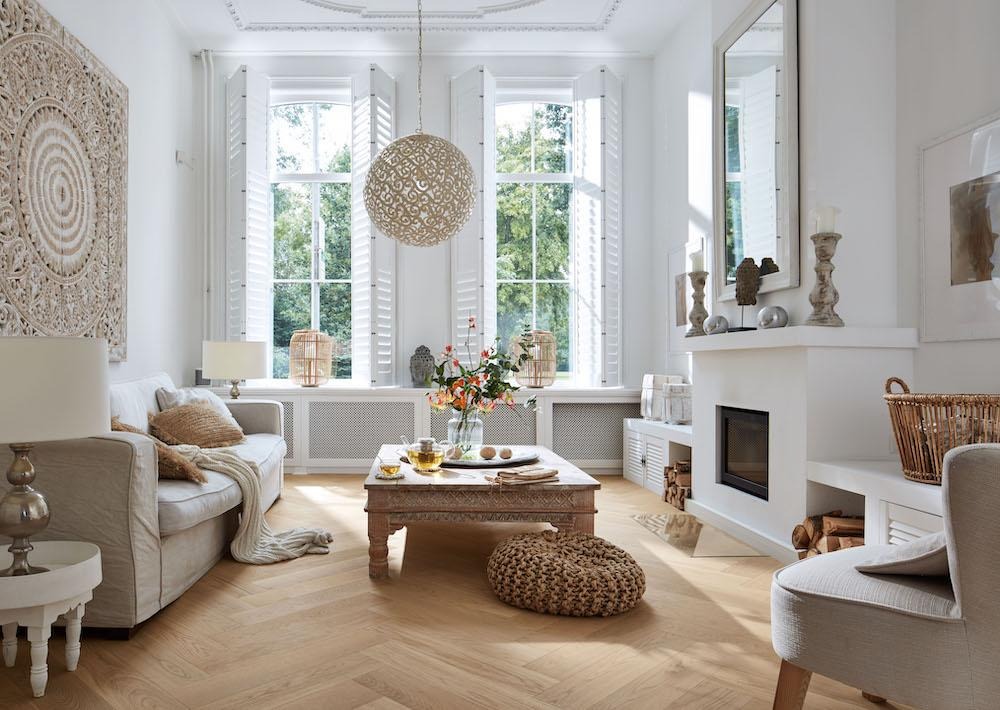
Parquet consists of smaller pieces of wood arranged into geometric patterns. One of the most recognisable designs is herringbone, although chevron and other patterns are also available.
Herringbone Flooring
Herringbone consists of rectangular pieces arranged at alternating right angles. It creates a distinctive zig-zag appearance and can work particularly well in living rooms, hallways and dining spaces.
Chevron Flooring
Chevron flooring has boards cut at an angle so that the ends meet to form a continuous V-shaped pattern.
It tends to create a more symmetrical and directional appearance than traditional herringbone.
Why Choose Parquet?
Parquet can become a major design feature in its own right. It can provide a sophisticated appearance without requiring additional decorative elements.
However, patterned flooring can involve more installation work and may require greater precision than standard straight boards.
4. Reclaimed Wooden Flooring
Reclaimed wood flooring is made using timber recovered from older buildings and structures.
It can be particularly appealing if you want a floor with genuine age, character and variation.
Boards may feature nail marks, knots, colour differences and other signs of previous use. Rather than being considered imperfections, these features are often part of the attraction.
Benefits of Reclaimed Wood
- Unique appearance
- Strong character and individuality
- Suitable for period and character properties
- Can complement traditional interiors
- Makes use of existing materials
Because reclaimed boards have had a previous life, their condition and dimensions can vary. Installation may therefore require additional preparation and expertise.
5. Oak Flooring
Oak is one of the most popular choices for wooden flooring in the UK.
It offers a combination of durability, attractive grain patterns and versatility. Oak can also be finished in numerous ways, from natural and lightly oiled surfaces to darker stains.
Oak flooring works well with both traditional and contemporary interiors, making it a dependable choice if you want flooring that is unlikely to look dated quickly.
6. Walnut Flooring
Walnut is known for its deeper natural colouring and distinctive grain.
It can create a warmer, richer appearance than lighter woods and is often selected for more dramatic interior schemes.
Walnut flooring can work particularly well in larger rooms where its darker tones can become a feature rather than making the space feel overly enclosed.
7. Ash Flooring
Ash generally offers a lighter appearance with a noticeable grain pattern.
It can be a good choice for homeowners who want natural wood flooring without the deeper tones associated with species such as walnut.
Its lighter appearance can also work well in contemporary interiors where a bright and open aesthetic is desired.
8. Pine and Other Softwood Flooring
Softwood flooring, including pine, can provide a more traditional and characterful appearance.
Compared with many hardwood options, softwood can be more susceptible to dents and surface wear. However, this can sometimes be part of its appeal, particularly in rustic or period-inspired interiors.
With the right finish and maintenance approach, softwood flooring can develop an attractive aged appearance over time.
Solid vs Engineered Wood Flooring
One of the most common questions homeowners have is whether they should choose solid or engineered wood flooring.
| Feature | Solid Wood | Engineered Wood |
| Construction | Single piece of wood | Multiple layers with real wood top |
| Stability | More susceptible to movement | Generally more dimensionally stable |
| Appearance | Fully natural wood | Real wood surface |
| Refinishing | Can often be refinished multiple times | Depends on wear-layer thickness |
| Underfloor heating | Requires careful consideration | Often suitable where manufacturer permits |
| Longevity | Potentially very long-lasting | Potentially very long-lasting |
| Installation | Can require specialist installation | Often offers more installation options |
Neither option is automatically better. The right choice depends on the property, room and intended use.
Choosing the Right Wooden Flooring for Each Room
Different areas of your home have different demands.
Living Rooms
Living rooms are often ideal locations for wooden flooring. Solid or engineered boards can create a warm and sophisticated foundation for furniture and décor.
Herringbone or chevron patterns can also create a strong visual feature.
Hallways
Hallways experience regular foot traffic, so durability should be an important consideration.
A robust wood species and appropriate protective finish can help the floor cope with everyday use.
Bedrooms
Bedrooms generally experience less foot traffic, giving you more flexibility when choosing your preferred style.
Lighter woods can create an airy, relaxing atmosphere, while darker flooring can produce a warmer and more luxurious feel.
Dining Rooms
Wood flooring can work particularly well beneath dining furniture. However, spills should be cleaned promptly and the floor should be maintained according to the manufacturer’s recommendations.
Kitchens
Wood flooring can be used in some kitchens, but careful product selection and maintenance are essential.
Engineered wood is often considered for kitchens because of its dimensional stability, but no wood flooring should be treated as completely unaffected by moisture.
Bathrooms
Bathrooms require particular caution. Wood and excessive moisture are not always a good combination, so homeowners should check whether a specific flooring product is suitable for the intended environment.
Where moisture exposure is significant, alternative flooring materials may be more appropriate.
What Wood Flooring Finish Should You Choose?
The finish can dramatically change the appearance and performance of your floor.
Oiled Flooring
Oil can enhance the natural appearance of wood while providing a protective surface.
One advantage is that some oiled floors can be maintained or refreshed without completely refinishing the entire floor, depending on the product.
Lacquered Flooring
Lacquer creates a protective surface over the wood.
It can provide good resistance to everyday wear and may be available in different sheen levels, including matt and satin finishes.
Brushed Finishes
Brushing removes some of the softer material from the surface of the wood, emphasising its natural grain and texture.
This can produce a more tactile and characterful appearance.
What About Wood Flooring and Underfloor Heating?
Underfloor heating has become increasingly popular in UK homes, particularly in extensions, renovations and new-build properties.
However, not every wooden floor is suitable.
Engineered wood is commonly considered for underfloor heating because its construction can provide greater dimensional stability than solid boards. Nevertheless, compatibility depends on the specific flooring product and heating system.
Always check the flooring manufacturer’s recommendations before installation.
How Is Wooden Flooring Installed?
The installation method depends on the flooring type and the property.
Common methods include:
- Floating installation – boards are installed over an appropriate underlay without being directly fixed to the subfloor.
- Secret nailing – boards are mechanically fixed to a suitable timber subfloor.
- Glue-down installation – flooring is bonded directly to the prepared subfloor.
- Combination systems – some products use specific combinations of adhesive, mechanical fixing or interlocking systems.
The subfloor needs to be properly prepared before installation. Unevenness, moisture problems or inadequate preparation can affect the performance and appearance of the finished floor.
Preparing Your Home for Wooden Flooring
Preparation is just as important as choosing the flooring itself.
Before installation, consider:
Subfloor Condition
The subfloor should be clean, sound, sufficiently level and suitable for the chosen installation method.
Moisture
Moisture levels need to be checked where appropriate, particularly when installing wood flooring over concrete or other potentially moisture-sensitive substrates.
Acclimatisation
Some wooden flooring products need to acclimatise to the room before installation. Follow the manufacturer’s instructions rather than assuming every product requires the same preparation.
Expansion Gaps
Wood naturally responds to changes in its surrounding environment. Appropriate expansion allowances may therefore be required around the perimeter of the room.
How to Maintain Wooden Flooring
Good maintenance can help preserve the appearance of your floor for years.
Regular Cleaning
Remove dust and loose dirt regularly using a suitable vacuum or soft brush.
For deeper cleaning, use products recommended specifically for your flooring finish. Avoid excessive water.
Deal With Spills Quickly
Although wood flooring can cope with normal household use, standing moisture should not be allowed to remain on the surface.
Wipe up spills promptly to reduce the risk of staining or moisture damage.
Protect High-Traffic Areas
Entrance mats can help prevent outdoor dirt and grit from being brought onto the floor.
Felt pads beneath furniture can also help reduce scratching.
Consider Refinishing
Depending on the flooring type and construction, sanding and refinishing can restore tired-looking surfaces and extend the useful life of the floor.
Common Mistakes to Avoid
Choosing wooden flooring is an investment, so it is worth avoiding some common mistakes.
Choosing Based Only on Appearance
A floor might look perfect in a showroom but may not be suitable for your particular room.
Consider moisture, traffic, heating, subfloor construction and maintenance requirements as well as appearance.
Ignoring the Subfloor
Even high-quality flooring can perform poorly if installed over an unsuitable or poorly prepared subfloor.
Using Too Much Water
Wood and excessive moisture are not a good combination. Always follow the recommended cleaning method for your specific flooring.
Forgetting About Furniture
Heavy furniture can affect a wooden floor, particularly if it is moved incorrectly. Use suitable protective pads and take care when repositioning furniture.
Buying Without Checking the Specification
Engineered wood flooring can differ considerably from one product to another. Check the construction, wear layer, finish, dimensions and installation requirements before purchasing.
How Much Does Wooden Flooring Cost in the UK?
The cost of wooden flooring varies considerably.
Factors affecting the overall price include:
- Type of flooring
- Wood species
- Board dimensions
- Flooring pattern
- Finish
- Quality and thickness
- Installation method
- Subfloor preparation
- Removal of existing flooring
- Room size
- Additional trims and finishing work
Parquet patterns such as herringbone and chevron may involve higher installation costs because of the additional precision required.
For an accurate project budget, it is best to obtain quotations based on your specific property and flooring requirements rather than relying solely on a general price per square metre.
How to Choose the Best Wooden Flooring for Your Home
There is no single type of wooden flooring that is perfect for every UK property.
Start by considering where the flooring will be installed and how much everyday use it will receive.
Next, think about the appearance you want. Do you prefer wide contemporary boards, traditional narrow planks or a decorative parquet pattern?
You should then consider practical requirements such as underfloor heating, moisture exposure, maintenance and the condition of the existing subfloor.
Finally, think about longevity. A good-quality floor that suits your property and is properly installed can provide many years of service.
Final Thoughts
Wooden flooring can combine practicality, durability and timeless style, making it an excellent choice for many UK homes.
From traditional solid wood flooring and versatile engineered wood to decorative herringbone, chevron and characterful reclaimed boards, there is a wide range of options available.
The key is to look beyond colour and appearance. Consider the room, subfloor, installation requirements, moisture levels, heating system, maintenance and long-term expectations before making your decision.
With the right product, professional installation and appropriate care, wooden flooring can become one of the most attractive and enduring features of your home.